

Other app builders email me regularly, asking to be added to this article. So you should know who’s writing it: I’m Nicolo Stanciu, and I build NFC.cool Business Card, one of the apps below.
There’s no ranking here, because the right card depends on who’s buying. What you’ll find is a list of situations, and for each one the product I’d look at first. For most individuals and small teams, my pick is NFC.cool, and I’ll explain why at the end.
Updated November 5, 2026. Every price and plan here was re-read on that date. Linq is no longer in the list, because it has moved on to something else (more on that further down).
How I compared them
The facts about other companies in this article come from each company’s current public pricing and feature pages, checked on November 5, 2026, while NFC.cool is the one product here that I build and use. That makes this a reading of what they publish, not a hands-on review, so try anything that matters to you before you commit.
I looked at the same things for each one:
The free plan: what it gives you, and whose name stays on your card
The published price, including seat minimums
NFC: whether you can use tags you already own
Team controls: CRM sync, single sign-on and directory sync
Languages, using each app’s App Store listing
Privacy: what gets recorded, and who contacts the people you meet
The short version
| If you… | Look first at | Because |
|---|---|---|
| Want a free card and don’t plan to pay | Wave Connect | Lead form and analytics on the free plan |
| Are one person and will pay a little | NFC.cool Personal or Pro | $19.99 or $49.99 a year, the lowest published subscription here |
| Work across languages | NFC.cool | 35 languages on its App Store listing |
| Want NFC on tags you already own | NFC.cool or HiHello | Both say you can write your card to any tag |
| Run a team of 2 to 4 and want CRM sync | NFC.cool Team | $100 a year for 2 seats |
| Want quick answers from the founder | NFC.cool | You write to the person who builds it |
| Need SSO or directory sync | NFC.cool Team, or HiHello, Blinq and Wave | Set up on request at NFC.cool, part of a plan at the others |
| Are buying for trade shows | Popl | Built around event lead capture |
| Want a physical card people remember | V1CE or Mobilo | Metal, bamboo and custom cards |
If you want a free digital business card
Wave Connect has a generous free plan. It includes a digital card, unlimited sharing, Apple and Google Wallet, individual analytics and a lead capture form.
One thing to check. Wave’s FAQ says it adds no branding, but its pricing page lists “Remove Wave Connect branding” as a Pro feature. Those two pages don’t agree, so look at your own free card before you rely on either.
Blinq and HiHello each offer two free cards and a free email signature. Blinq’s free plan adds a contact scanner, and its name stays on your card until you pay for Premium. HiHello’s gives you five scans a month.
NFC.cool’s Free plan gives you one card, sharing by NFC, QR code or link, Save Contact, Conference Mode’s QR code, Apple Wallet and a PIN. Paid plans add lead capture and analytics.
If you’re one person and happy to pay a little
This is where NFC.cool wins on price. Personal is $19.99 a year for one card, and Pro is $49.99 a year for 10 cards. Both remove our name, add lead capture and analytics, and come with a one-week free trial.
Billed yearly, the others work out at $72 for HiHello Professional (8 cards), $84 for Wave Pro and about $88 for Blinq Premium (5 cards). For the extra money, HiHello Professional includes 20 scans a month with contact enrichment, and Wave Pro adds AI lead capture.
If you work across languages
NFC.cool’s App Store listing shows 35 languages. On the same day, HiHello’s listed 3, and Blinq’s, Popl’s, Wave’s and Mobilo’s each listed English only. The App Clip is translated too, so someone opening your card on an iPhone sees the buttons and labels in their own language.
If you want NFC without buying someone’s card
NFC.cool works with any writable NFC tag, on every plan including Free: a sticker, a coin, a key fob, a wristband. The tag holds a link to your card, so it stays current when you edit the card. I don’t sell tags, so you can buy them anywhere. If you want a starting point, I keep a recommended tags page with affiliate links.
HiHello says the same thing: it doesn’t sell hardware, and you can write your card to any NFC tag you already own. Its pricing page does list NFC card programming under the paid Professional plan, so check which applies to you.
Blinq, Wave, Mobilo and V1CE all sell their own cards. I couldn’t find any of them documenting third-party tags on the pages I read, which doesn’t prove you can’t use one.
If you’re a small team
On published prices, NFC.cool Team is the cheapest subscription team plan I could find for 2 to 4 people with CRM sync included. It costs $50 per person a year, or $5 a month, and you can start with two seats. That’s $100 a year for 2 people, against $180 for Wave (3 minimum), $299.40 for Blinq and $300 for HiHello (both 5 minimum). In euros, the team price is the same number.
| Team plan | Per seat, billed yearly | Minimum | Lowest yearly bill | CRM sync on that plan |
|---|---|---|---|---|
| NFC.cool Team | $50 | 2 seats | $100 | HubSpot, webhooks |
| Wave Teams | $60 | 3 users | $180 | HubSpot, Salesforce, Dynamics 365, Zoho, Pipedrive, HighLevel |
| Blinq Business | $59.88 per card | 5 cards | $299.40 | HubSpot, Salesforce, Dynamics 365 and more |
| HiHello Business | $60 | 5 users | $300 | Salesforce, HubSpot, Dynamics |
| Mobilo Teams | $48, plus $10 for the CRM add-on and a card from $10 once | Not stated | Book a demo | Add-on |
| Popl | Not published | No per-seat charge | Quote only | Salesforce, HubSpot, Marketo and more |
Read from each company’s pricing page on November 5, 2026. Prices change, so check before you buy. The yearly totals are my arithmetic, and I didn’t compare how each company handles tax.
Two others are priced differently, so they aren’t in that table. Mobilo’s Pro column lists a free user license “up to 5 users”, cards from $4.99 once and a $20-a-year CRM add-on. V1CE charges once per card, from €74, with up to 30% off for 5 or more. Their pages didn’t spell out which team admin tools come with those, so ask them.
Here’s what NFC.cool Business Card for Teams gives you: a card for each person (up to 10 per person), your company brand locked on every card, a web dashboard with roles and invites, a shared leads inbox, insights card by card, HubSpot and webhooks, branded and automatic follow-up emails, and a way to connect your AI assistant. When someone leaves, their leads stay with the team. The 14-day trial needs a payment card.
If your company needs SSO or directory sync
NFC.cool Team can add both on request. Tell me what your company uses, and I’ll set up single sign-on and directory sync for you.
Here’s how the others list them:
HiHello’s self-serve Business plan for 5 to 100 users includes Google and Microsoft SSO, plus directory sync with Google Workspace and Entra ID. Enterprise, at 100 users and up, adds SAML and SCIM for Okta, Workday or any other provider.
Blinq recommends its Enterprise plan above 100 people, with enforced SSO and SCIM. It calls itself #1 in digital business cards on G2.
Wave’s Enterprise plan, also aimed at 100 people and up, has enforced SSO and SCIM.
Mobilo advertises SAML SSO and HRIS provisioning too, though its pricing page doesn’t say which plan includes them.
If events are the reason you’re buying
Popl. It calls itself an AI GTM platform for event lead capture, and the product reads that way: a badge scanner it says works at any event, qualifying questions, contact enrichment, CRM sync and ROI reports. It says it’s trusted by 90% of the Fortune 500.
The catch is the price. In its own words, “we quote pricing over a meeting instead of publishing it on our website”. What it does promise is no per-seat charges and no usage fees. If you need a number before you talk to anyone, Popl can’t give you one. It also has a free plan and Pro plans for individuals, but teams are clearly where its attention is.
Wave, Blinq and HiHello scan badges too, priced differently. Wave sells credits, at $2.50 each on the pack its pricing page shows by default, and a badge uses four. Blinq lists $9.99 per lead captured and enriched. HiHello Business includes 50 scans per user a month, pooled across the team.
NFC.cool works the other way around: Conference Mode pins your QR code to your Lock Screen on iPhone and Android, so people scan you without you unlocking your phone. On paid plans, views, saves and new leads count up right there, and you can tag every lead from an event.
If you want a physical card that makes a statement
V1CE is built for this. It sells metal, bamboo and 24K gold cards, and its cheapest card, the Original, is €74 once with no monthly fee (shown in euros when I checked). Lead capture, CRM sync, booking and follow-ups come free with the card. An optional AI plan costs €59.10 a month, and the free plan takes 5% if you sell services through your page.
Mobilo covers the cheaper end, with a Mobilo-branded card at $4.99, custom classic at $19.50 and wood at $29.50. Its page shows the custom metal card at both $49.50 and $69, and a discount banner was running when I read it, so check before you order.
With NFC.cool, you can put your card on any NFC card or tag you already own.
The privacy questions worth asking
Here are the questions I’d ask, plus what each company says about itself.
Does it record conversations? Blinq’s AI Notetaker and Popl’s AI Voice both record in-person conversations, and V1CE’s AI plan includes a note taker for Zoom, Meet and Teams. That can be really useful. Blinq says plainly that you are responsible for getting consent from everyone you speak with, that it keeps in-person audio for 90 days on its free plan and for the life of your subscription on Premium or Pro, and that your recordings aren’t used to train AI. NFC.cool doesn’t record conversations.
Does it look people up? Most of the rivals here offer contact enrichment, which fills in details about the people you meet from other sources. Sales teams want exactly that. Blinq’s privacy policy says it may collect information about people who aren’t Blinq users, including from third-party data providers, and gives them a way to opt out. NFC.cool has no enrichment.
Who contacts the people you meet? Ask, and don’t assume. Wave’s FAQ says recipients “never get solicited by Wave”. NFC.cool doesn’t send marketing to people who view your card either. On Team, follow-up emails are your team’s own: they go out under the sender’s name “via NFC.cool”, replies go to that person, and each one has an unsubscribe link.
What happens to your data? Wave, Blinq, HiHello and NFC.cool all say in writing that they don’t sell it. On NFC.cool you can protect a card with a 4-digit PIN, keep a private card out of search engines, download everything as a ZIP and delete your account. The Business Card app has no ads.
All the prices in one place
Checked November 5, 2026, so treat this as a snapshot and look at each company’s page before you buy.
| Product | Free | For one person | For a team |
|---|---|---|---|
| NFC.cool | 1 card with sharing and Apple Wallet, shows “Made with NFC.cool” | Personal $19.99 a year (1 card), Pro $49.99 a year (10 cards) | $50 per person a year or $5 a month, from 2 seats, up to 10 cards per person |
| Wave | Yes, with lead form and analytics | Pro $7 a month, billed yearly | $5 per user a month, billed yearly, from 3 users |
| Blinq | 2 cards | Premium $7.33 a month billed yearly, or $9.99 monthly | $4.99 per card a month billed yearly, or $6.99 monthly, from 5 cards |
| HiHello | 2 cards | Professional $6 a month billed yearly, or $8 monthly | $5 per user a month billed yearly, or $6 monthly, from 5 users |
| Popl | Free plan for individuals | Pro and Pro+, prices not on the pages I read | Quote only |
| Mobilo | Free digital card | Free license, cards from $4.99 once | $48 per employee a year, plus a card from $10 once |
| V1CE | Software free with a card | Card from €74 once | Same card, up to 30% off for 5 or more |
NFC.cool’s Personal and Pro are bought in the app, and Team on the web.
What happened to Linq? It used to be in this article. linqapp.com now pitches “APIs for iMessage, RCS, SMS, and Voice built for Agents”, its homepage pitch doesn’t mention business cards, and its own AI context page says “Linq once sold digital business cards. Linq has pivoted.” Its card apps were still being updated in August 2026. If you’re a Linq customer, ask them what that means for your cards.
Why I’d pick NFC.cool
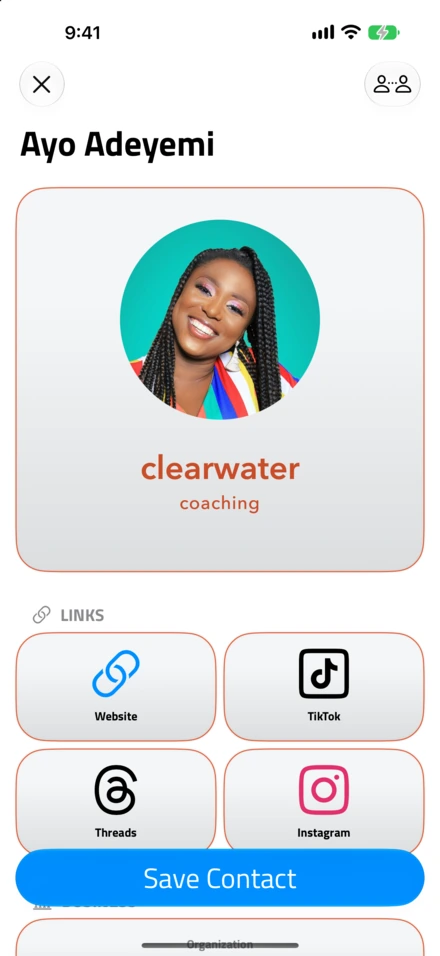
- NFC.cool Business Card. The App Clip on iPhone, in the recipient's language, with your colours and logo.
Sure, it’s my product, and I love it. I’m passionate about it, and I keep improving it.
NFC.cool Business Card is a native app for iPhone and Android. You share by NFC tap or QR code, and the other person doesn’t need an app: your card opens in an App Clip on iPhone, and in the browser on Android and computers. Either way, they can save you as a contact.
Beyond that, here’s why I think it’s the right choice for most people and small teams:
Quick answers from the founder. When you write to NFC.cool, you hear from me, the person who builds it. Reviews say it better than I can: “Business card creation is intuitive and contact with support was swift and pleasant.”
No venture capital. NFC.cool isn’t VC-backed. No investor is pushing it to grow at any cost, so the people I answer to are the ones using the app.
Your data isn’t for sale. NFC.cool doesn’t sell your data to anyone, and the Business Card app has no ads.
Real native apps. It’s built natively for iPhone and Android, not a website in a wrapper. That’s what lets your card sit on the Lock Screen in Conference Mode, and open in an App Clip on iPhone with nothing to install.
The second chance. If someone closes your card without saving it, their iPhone’s Lock Screen reminds them. I haven’t seen a rival claim this.
Lead capture on your terms. On paid plans, ask for their details before they save you, after, or not at all.
Cards that follow the viewer. Your logo and colours, in the viewer’s light or dark mode.
How products get into this list
Nobody pays to be here, and I don’t trade a mention for a link back. If you build a digital business card, you can suggest it through my contact page.
Bottom line
The right card depends on who’s buying. Wave has a generous free plan, Popl is built for trade shows, and V1CE makes beautiful objects.
For most individuals and small teams, I’d pick NFC.cool Business Card. It has the lowest published subscription here for one person, and the cheapest subscription team plan I could find for 2 to 4 people with CRM sync. You get native apps on iPhone and Android, nobody sells your data, there are no venture investors behind it, and when you have a question, the founder answers quickly. If your company needs single sign-on, ask me and I’ll set it up.
You can read about the NFC.cool digital business card and its plans, start a team with a 14-day trial, or get the app on the App Store or Google Play.

