I’ve spent years building NFC.cool, an app for reading and writing NFC tags, so I tend to notice when NFC quietly turns up in the news. The EU Digital Product Passport (DPP) is the biggest example I’ve seen yet - and it caught my attention because the regulation effectively writes NFC into law. If you sell physical products in Europe, or buy them, this is a regulation worth understanding. It’s no longer a future concept. It’s happening right now.
Under the Ecodesign for Sustainable Products Regulation (ESPR), which entered into force in July 2024, every covered product sold in the EU will need a machine-readable digital record containing verified data about its materials, environmental impact, and end-of-life handling.
Batteries are already under the first enforcement wave. Textiles, electronics, and furniture deadlines are approaching fast.
I’m not a lawyer, and this isn’t legal advice - but I do work with the technology at the center of it every day. Here’s my read on what it all means, in plain language, with the regulatory facts kept straight.
What Is a Digital Product Passport?
A Digital Product Passport (DPP) is a structured digital record attached to a physical product. The way I think of it: it’s a product’s complete biography. Where it came from, what it’s made of, how it was produced, and how it should be recycled or disposed of when its life is over.
But it’s not a PDF or a webpage, and that distinction matters. A DPP is a standardized, machine-readable data layer linked to a specific product unit or product model. It’s designed to be read by consumers, regulators, retailers, and recyclers - each seeing the data relevant to them.
How Do You Access It?
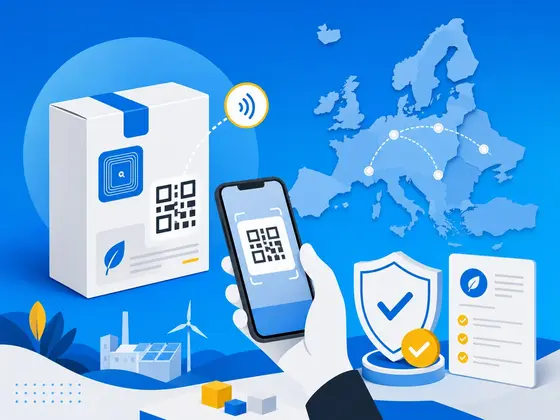
Consumers and inspectors access a DPP by scanning a QR code or NFC tag physically attached to the product or its packaging. The scan opens a structured data record hosted on compliant digital infrastructure.
This is the part that made me sit up. A regulation this large is, in practice, going to put an NFC tag on millions of products - and that’s where the technology I work on becomes central to the story. More on that below.
Why Is the EU Doing This?
The DPP exists because Europe’s circular economy goals require radical product transparency. Right now, most products carry minimal information about their environmental footprint. Labels tell you fiber composition or energy ratings, but not the full picture. If you’ve ever tried to find out what’s actually inside something you own, you know how thin that information usually is.
The EU wants to change that with three goals:
Consumer empowerment - Let people make informed purchasing decisions based on real sustainability data.
Regulatory enforcement - Give market surveillance authorities the ability to verify compliance automatically, not through manual inspections.
Circular economy - Provide recyclers and repair services with the information they need to handle products properly at end of life.
The mechanism is the ESPR (EU Regulation 2024/1781), which creates the legal framework. Specific requirements for each product category are defined through delegated acts - separate legal instruments that spell out exactly what data must be included.
The Timeline: What’s Covered and When
The DPP rollout is phased by product category, which I think is the sensible call - one big-bang deadline would have been chaos. Here’s the current schedule as of early 2026:
Already in Force
Batteries (February 2027 full enforcement) - Industrial batteries over 2 kWh, automotive batteries, and light transport batteries. Over 100 data attributes required, including material composition with geographic origin, carbon footprint by lifecycle stage, recycled content percentages, and state-of-health metrics.
Coming in 2027
Textiles & Apparel - Fiber composition (all fibers above 1% by weight), chemical treatments, water consumption, worker welfare documentation, and care instructions for durability.
Electronics & ICT - Material composition, repairability index (EU scoring methodology), spare parts availability, and hazardous substance compliance under REACH.
Coming in 2028
Furniture - Material composition, durability metrics, disassembly instructions, and material separation guidance.
Construction Products - Material content, environmental performance data, and recycled content.
Tyres - Material composition, rolling resistance, and end-of-life information.
More categories are expected through 2030 as additional delegated acts are issued.
What Data Does a DPP Contain?
While requirements vary by product category, certain fields are common across all categories:
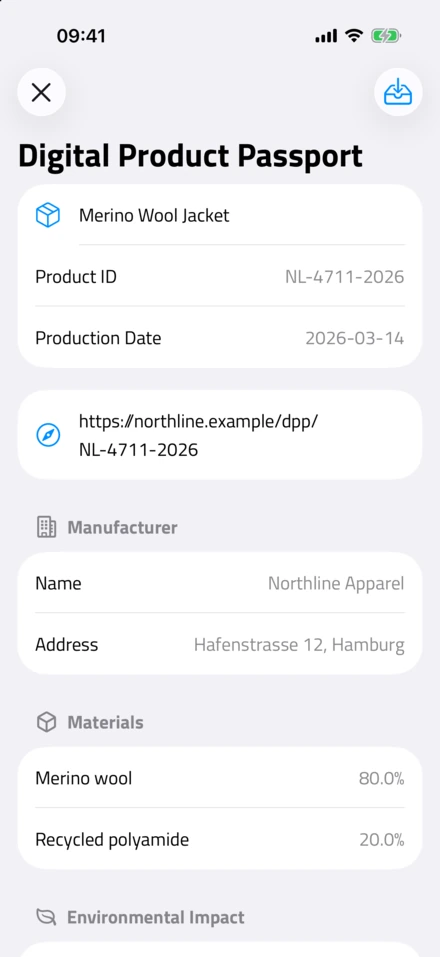
Material composition (by percentage weight)
Country of origin of manufacturing
Carbon footprint per unit (expressed as kg CO₂e)
Recycling and end-of-life instructions
Repairability or durability index (where applicable)
Hazardous substance information (REACH compliance)
Unique product identifier (linked to the physical data carrier)
Here’s the detail I find most interesting: the data isn’t static. DPPs can be updated after the product ships - meaning a brand can push new information (recall notices, updated recycling guidance, software updates for electronics) to products already in consumers’ hands. That only works because the tag points to a record rather than storing everything itself, which is exactly how I’d design it.
Tiered Access
Not everyone sees the same data. Access is structured by stakeholder:
Consumers see sustainability credentials, care instructions, and recycling guidance.
Retailers and trade partners see supply chain data and compliance certificates.
Regulators access the full dataset for market surveillance and automated compliance checks.
Recyclers access end-of-life processing instructions and material composition details.
NFC’s Role in Digital Product Passports
This is the part I’ve been waiting to write about. For me, NFC has always been a handy consumer tool - a way to automate your home, share a contact, tap a tag and make something happen. The DPP is the moment it becomes critical infrastructure.
The ESPR mandates standardized data carriers for product passports. The three approved technologies are:
QR codes - Printed on products or packaging. Universal, cheap, but static and easily damaged.
RFID tags - Used in logistics and warehousing. Longer range but require specialized readers.
NFC tags - Embedded in products or attached to packaging. Scannable with any modern smartphone.
For consumer-facing products, NFC is emerging as the premium choice - and having built around these chips for years, I’d argue the reasons are solid rather than hype:
Why NFC Fits DPP Better Than QR
Durability - NFC tags can be embedded inside products (clothing labels, battery housings, electronic casings). They survive washing, wear, and years of use. QR codes on packaging get thrown away. This is the one that convinces me most: a passport that has to last a product’s whole life can’t live on a label that gets binned on day one.
Tamper resistance - NFC chips can be cryptographically locked, making it harder to forge or duplicate passport data. QR codes can be printed by anyone. Locking a tag is a deliberate, one-way step, and for a regulatory data carrier that’s exactly the property you want.
Updateable links - NFC tags can point to dynamic URLs, ensuring the passport data stays current throughout the product’s lifecycle.
No line-of-sight needed - You don’t need to find and frame a QR code. Just tap your phone near the product. On most iPhones from the XS onward, that read happens in the background with no app at all.
Higher-value positioning - For premium products (luxury textiles, electronics, furniture), NFC signals quality and modernity.
I’ll be honest about the trade-off, though: QR codes remain essential as a fallback and cost-effective option for mass-produced, low-cost items. NFC is not free, and for a disposable item the math doesn’t always work. Most implementations will likely use both - NFC embedded in the product itself, QR printed on the packaging - and I think that’s the right answer rather than a compromise.
Writing NFC Tags for DPP Compliance
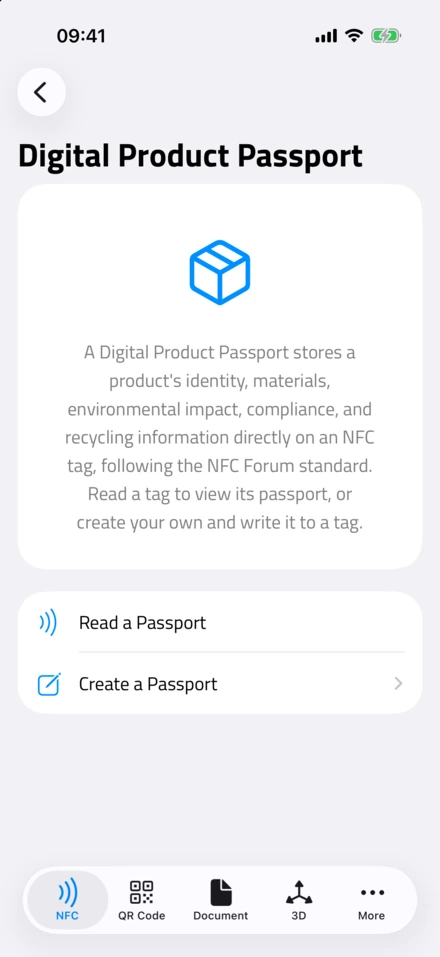
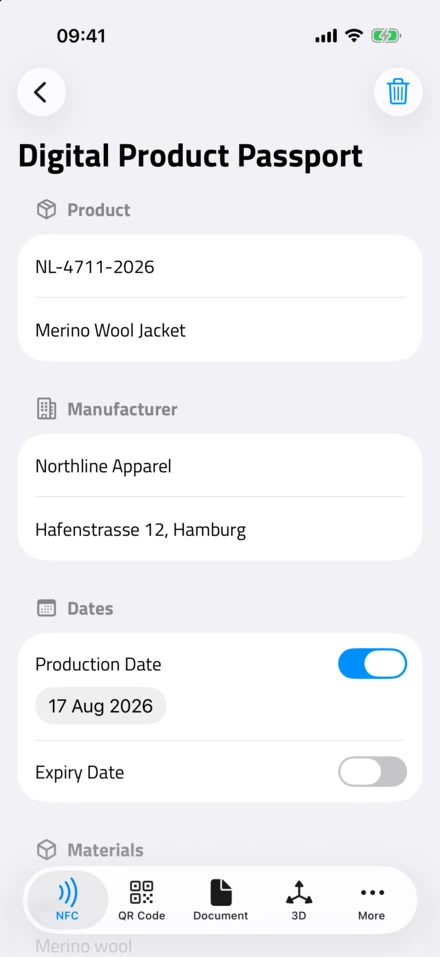
If you’re a manufacturer or brand implementing DPP via NFC, you’ll need tools to program NFC tags at scale with the correct URLs pointing to your passport data infrastructure. The underlying mechanics are not exotic - a DPP tag is, at heart, a tag carrying a URL record, the same thing I cover in my walkthrough on how to write NFC tags on iPhone.
This is exactly what apps like NFC.cool Tools are built for. It’s the app I build, and it lets you read, write, format, and lock NFC tags directly from your iPhone or Android device - no extra hardware required. For small-batch production, prototyping, or testing your DPP implementation, it’s the fastest way I know to get tags programmed and verified. If you’re choosing which chip to standardize on, my breakdown of NFC tag types for iPhone covers the practical differences, and for anything that needs the cryptographic locking the regulation rewards, an encrypted, tamper-resistant tag is worth understanding before you commit.
For enterprise-scale deployments, desktop NFC writers (compatible with NTAG, ICODE, and MIFARE chips) handle bulk programming, but the mobile app remains invaluable for field verification - scanning products on the shelf or warehouse floor to confirm the passport link works correctly. You can even check what a tag holds straight from a browser on Android, with nothing to install, which is handy for a quick spot-check.

Beyond the EU: Global Momentum
The EU is leading, but it’s not alone, and I don’t expect this to stay a European story for long.
China
China is developing a parallel state-administered DPP system led by the China Academy of Information and Communications Technology (CAICT). Their focus is on electric mobility and electronics, with a carbon credentialing system intended to reduce trade friction for Chinese exports to Europe.
United States
The US has no federal DPP mandate as of 2026. However, market forces are pushing adoption - especially for brands selling into both US and EU markets. Building DPP infrastructure once for EU compliance and extending it globally is becoming the pragmatic approach.
Global Interoperability
The big challenge ahead is making these systems talk to each other. A product manufactured in China, sold in Europe, and recycled in the US needs a passport that works across all three jurisdictions. Standards bodies (CEN/CENELEC in Europe, ISO/IEC internationally) are working on harmonization, but it’s still early days.
What Should Businesses Do Now?
If your products fall under ESPR categories, here’s the practical action plan I’d follow:
1. Audit Your Data
Start with what you know - and, more honestly, what you don’t. Map your supply chain data against DPP requirements for your product category. The gaps you find now are cheaper to fix than the ones regulators find later.
2. Start with One Product
Don’t try to implement DPP across your entire portfolio simultaneously. Pick one product line (ideally in the earliest enforcement category) and use it as a pilot. Validate your data flow before scaling. I’ve watched enough projects overreach early to believe this one strongly.
3. Choose Your Data Carrier
Decide whether QR, NFC, or both make sense for your product. Consider the product’s lifespan, value, and where the data carrier will be placed. My rule of thumb: for anything consumers keep longer than a year, NFC is worth the investment.
4. Build Updatable Infrastructure
Your DPP needs to last as long as your product does. That means the data must be hosted on infrastructure that will persist, with the ability to update records post-sale.
5. Get Your NFC Tooling Ready
If you’re going the NFC route, get familiar with tag programming before it’s a deadline. NFC.cool Tools supports reading, writing, and verifying NFC tags on both iOS and Android - it’s the app I build, and it’s a practical starting point for testing your DPP tags before committing to bulk production. If you want the bigger picture of what NFC can do beyond passports, my NFC reader and writer feature overview lays it out.
Frequently Asked Questions
Is the Digital Product Passport mandatory?
Yes, for products sold in the EU market that fall under covered categories. The ESPR (EU Regulation 2024/1781) makes it a legal requirement, enforced through CE marking and market surveillance.
When does my product need a DPP?
It depends on your category. Batteries are already covered (2027 full enforcement). Textiles and electronics follow in 2027. Furniture, construction products, and tyres in 2028. Check the latest delegated acts for your specific category.
Does DPP apply to products manufactured outside the EU?
Yes. Any product placed on the EU market must comply, regardless of where it was manufactured. This includes imports.
Can I just use a QR code?
Technically yes - QR codes are an approved data carrier under ESPR. But for durable products, I’d push back: NFC tags offer significant advantages in longevity, tamper resistance, and user experience, and those advantages compound over a product that lives for years.
What happens if I don’t comply?
Non-compliance can result in products being removed from the EU market, seizure by customs, and financial penalties. CE marking requires DPP compliance for covered categories.
How much does DPP implementation cost?
Costs vary widely depending on your product category, data readiness, and chosen infrastructure. NFC tags cost a few cents each at scale, so in my experience the chips are never the expensive part. The bigger investment is in data collection, system integration, and ongoing hosting.
The Bottom Line
In my view, the EU Digital Product Passport isn’t just another regulation to comply with - it’s a fundamental shift in how products communicate their story. For manufacturers, it means more transparency. For consumers, more informed choices. For the planet, better recycling and less waste.
I’ll admit a bias here, since NFC is what I build. But I genuinely think the technology is uniquely positioned to be the physical bridge between products and their digital identities. It’s durable, secure, smartphone-compatible, and already proven at scale - and a regulation this size effectively confirms that the bet was the right one.
Whether you’re a brand preparing for compliance or a consumer curious about what that new NFC tag on your jacket does, the DPP era has begun. And if you’ve never thought much about the chip behind it, my beginner’s guide to NFC tags is the place I’d start.
Need to read, write, or test NFC tags? NFC.cool Tools is available for free on iOS and Android.